
Often, people with single-sided deafness can follow conversations in quiet settings. This can give your friends and family the impression that your hearing loss is only a minor issue. But single-sided deafness has a significant impact on your quality of life and should be recognized as a serious burden.
Listening with only one ear takes so much more mental effort to separate what you want to hear from background noise. You can’t tell where sounds are coming from, which can make you feel disoriented and overwhelmed.
This can leave you struggling to follow conversations at work or always having to turn your hearing ear to understand a friend, or worrying that you won’t notice sudden warning noises when crossing the street.
At MED-EL, our philosophy is to provide a closer match to natural hearing with our cochlear implants. The idea is simple: Provide a closer match between both ears so that both ears can work better together.
This makes it easier to match any hearing aid, including the hearing aid you’re wearing right now. By letting both ears hear their best, both ears can work together better.
What Is Sensorineural Hearing Loss?
Sensorineural hearing loss is a type of hearing loss caused by problems in the inner ear (cochlea) or the auditory nerve. These problems affect how sound signals reach the brain. The inner ear contains tiny hair cells that are responsible for converting sound into nerve signals that are then sent to the brain. But when these cells are damaged or when the auditory nerve doesn’t work properly, sound signals can’t be sent to the brain effectively.
The level of sensorineural hearing loss can vary from mild to profound. Individuals with profound hearing loss may be unable to hear even the loudest sounds. For individuals with milder hearing loss, the amplification a hearing aid can provide may be sufficient to enable them to hear.
Sensorineural hearing loss can make it particularly difficult to hear in noisy environments like restaurants, take part in group conversations, or communicate on the phone. The extra listening effort in these situations can lead to listening fatigue.
Treatment for sensorineural hearing loss depends on the cause and severity, as well as your ability to understand speech and hearing profile. If you have mild-to-moderate hearing loss, a hearing aid may be the best solution for you. If you have severe-to-profound hearing loss and hearing aids are no longer enough, a cochlear implant may be the right solution for you.
With the guidance of a professional who will consider both your audiogram and your individual needs, you can find the best solution for you.
Bimodal Streaming with DualSync
Ears work as a team, bringing together sounds for better word understanding, music appreciation, and localization. That is why Starkey has partnered with MED-EL, a pioneer in hearing implants, to offer bimodal streaming with DualSync Technology for people who use both a cochlear implant and a hearing aid.

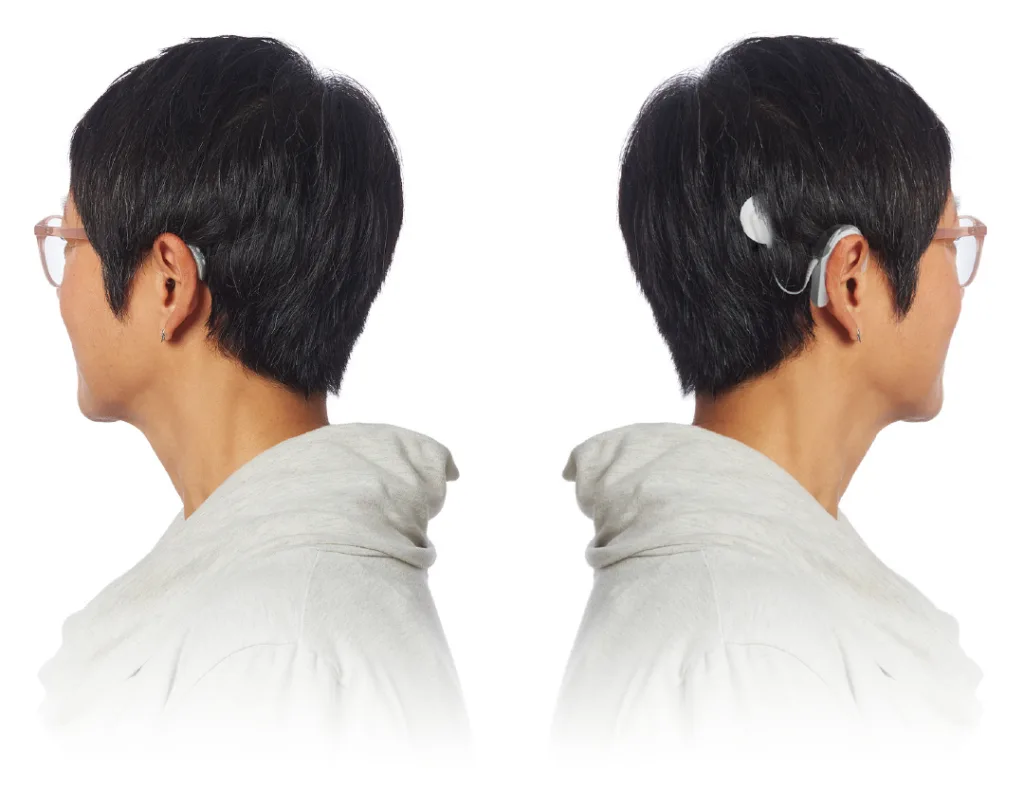
A purposeful pair
MED-EL and Starkey are excited to introduce DualSync—a bimodal streaming partnership enabling Apple technology to seamlessly stream to both hearing devices. For those who wear a MED-EL audio processor on one side and a Starkey hearing aid on the other, Apple devices will recognize them as a pair for a streamlined bimodal streaming experience.
Starkey Omega AI, Edge AI, G Series AI and Genesis AI wireless devices of any style are compatible with MED-EL Sonnet 3, Sonnet 2, Sonnet or Rondo 3 processors.
Bimodal hearing
“Bi,” meaning two, and “modal,” meaning mode, combines two ways for a patient to receive sound: a cochlear implant on one side and a hearing aid on the other. This can be the case with bilateral hearing loss, where one ear’s hearing or word understanding is significantly poorer than the other, but both ears need stimulation.

Check device compatibility

Using your mobile device camera, scan the QR code.
Using the device you are on, tap or click the on the button above